
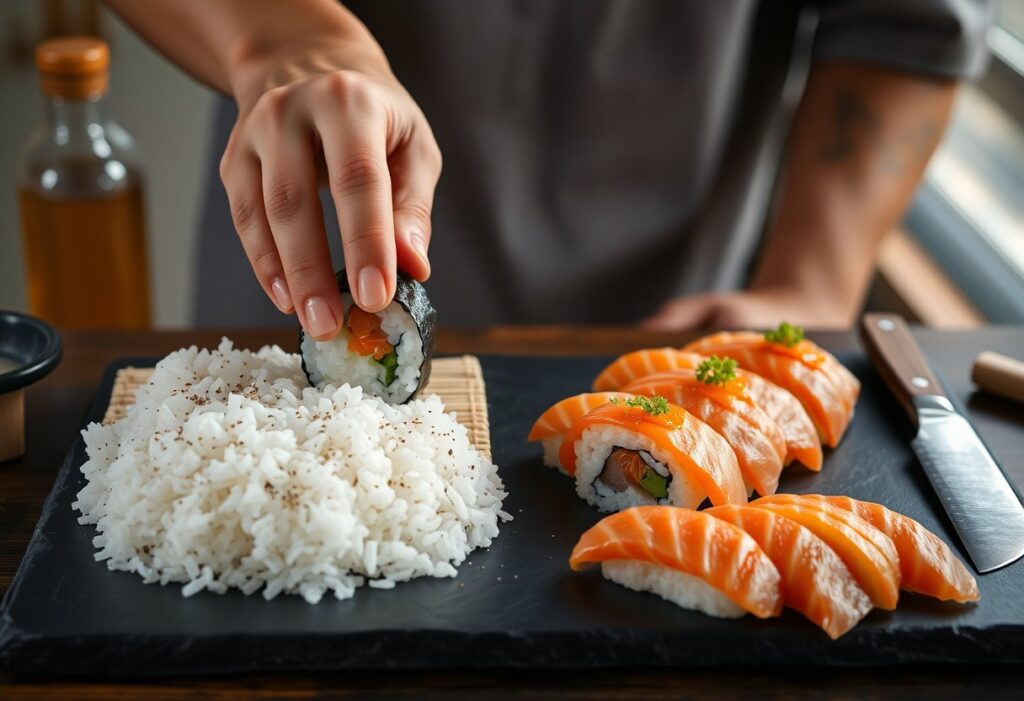
You will learn precise rice preparation, proper seasoning and rolling technique; make sure your hands are clean and fresh ingredients; avoid unsafe raw fish to minimize risks; this way you can achieve evenly perfect wheels.
Key Takeaways:
- Perfect rice: Wash several times, proper rice-water ratio, steam and let rest briefly, then carefully season with warm sushi vinegar (rice vinegar, sugar, salt) and cool.
- Preparation: Use fresh ingredients and suitable equipment (nori, bamboo mat, sharp knife); Cut ingredients evenly and spread rice thinly.
- Roll & Cut: Hold mat loosely, roll evenly and press gently; cut with a damp, sharp knife in one go for clean slices.
Make your own sushi – timeless steps for perfect rice and rolls
Consistency and seasoning
Make sure that the rice remains shiny, sticky, but grainy : the right amount of rice, gentle stirring and vinegar-based seasoning are crucial. You can find more in-depth details here: How to make sushi yourself: The secrets of the perfect roll.
Temperature and handling
Let the rice cool to body temperature and avoid pressing it hot; hot humidity makes mats and nori unusable. Be sure to refrigerate leftover rice quickly, otherwise Bacillus cereus can become dangerous.
Razor-sharp discipline and tools
Blade and Care
Sharpness is your best ally: you hold a sharp knife for clean, safe cuts and avoid crushing. Care with sharpening rod and oil keeps the blade stable; Be careful when regrinding.
Cutting technology and safety
Pay attention to grip, angle and smooth movements: you reduce cuts and achieve precise rolls. Keep children away and use cutting boards with anti-slip protection as a positive safety measure.
The naked truth about fresh fish
Purchasing and security
Be sure to check the origin and smell of your fish; only quality-assured, frozen fish minimises the risk of parasites. Confirm sushi/sashimi quality when serving raw.
Processing and rice
Use firm texture and store cold, then combine with perfectly seasoned rice (sushi rice – basic recipe for Japanese glutinous rice) for optimal flavor results.
The geometry of rolling
Roll angle and pressure
Precision determines shape and strength: roll with a uniform angle and controlled pressure so that the filling does not break out. Avoid too much pressure, or the texture will be mushy; careful pressing results in a stable, aesthetic roller.
Cut and stability
When carving, make sure you have a sharp knife and clean strokes; too bluntly, tears too hastily. This way you achieve an even slice that guarantees presentation and bite.
The moment of truth at the cutting
First cut
At the first cut, you decide whether your rolls will hold: use a very sharp knife, dip it lightly, pull calmly in one go. Avoid too much pressure, otherwise you will squeeze the rice grains and destroy the optics.
Fine-tuning
Cut at a steady pace, so you achieve clean cuts and show the inner workings. As pieces break down, adjust more rice moisture and rolling tension until the perfect slices are formed.
Make your own sushi – timeless steps for perfect rice and rolls
You wash the sushi rice until the water runs clear, let it soak for 30 minutes, cook it in the right water-rice ratio and season it hot with sushi vinegar. Then fan and lift the rice carefully until it is lukewarm; spread over nori, place the filling in the middle and roll evenly with a bamboo mat but not too tightly; moisten the knife before each cut.
Control of rice consistency, vinegar quantity and rolling technique determines the result; with precise technique and repeated practice, you can create evenly structured, aromatic sushi rolls.
FAQ
Q: How do I prepare perfect sushi rice?
A: Wash rice thoroughly until rinse water runs clear (3-6 times), then soak for 30 minutes. Rice:water ratio usually 1:1 to 1:1.1, depending on the type of rice. Cook the rice in a tight pot or rice cooker with a lid, let it rest for 10-15 minutes after cooking. For the seasoning, gently heat 120 ml rice vinegar, 3 tablespoons sugar and 1 teaspoon salt for 500 g raw rice (cooked approx. 900-950 g) until the sugar and salt dissolve. Place the rice in a shallow wooden or plastic bowl (hangiri or large bowl), spread vinegar mixture evenly over the top, carefully “cut” with a wooden spatula and fan until the rice is shiny and lukewarm. Do not stir or pound too hard to keep the grains whole.
Q: What are the best types of rice and vinegar?
A: Use short- to medium-grain sushi/japonica rice (e.g., labeled “sushi rice”). Long-grain rice is not suitable because of its lack of stickiness. For the seasoning, adjust rice vinegar (not strong wine vinegar), alternatively light rice vinegar with sugar and salt. For fine flavor, a small dash of mirin or kombu infusion (algae water) can be added. Pay attention to the quality of the rice and the freshness of the vinegar for authentic flavor.
Q: How do I roll maki and uramaki neatly and evenly?
A: Place nori on the bamboo mat (maki) with the rough side up and spread a thin, even layer of rice (not too thick) to 1-2 cm from the top edge. Fill with fish/vegetables in a line at the bottom third. Roll over the filling with the help of the mat, press the edge and form a firm but not crushed roll. For uramaki rice on the outside: place cling film on the mat, spread rice on the outside and turn out a nori-covered inside on top, then roll. Press the roll lightly before slicing, cool briefly, then cut into even pieces with a damp, very sharp knife.
Q: What techniques help to cut cleanly without tearing?
A: Use a long, very sharp knife (sushi or Yanagiba style) and hold it in warm water before each cut so that rice does not stick; after each cut, wipe the knife and moisten it again. Cut downwards in a smooth stroke, avoiding sawing movements. Let the roll sit in a cool place for 5-10 minutes before cutting or form briefly in cling film with light pressure, so the pieces cut more cleanly. For an extra soft coating, stabilize the knife with a cloth.
Q: How long can homemade sushi be kept and how do I avoid food risks?
A: Cooked sushi rice should not be left at room temperature for long (max. 1-2 hours). Sushi with raw fish: use only high-quality fish approved for sushi and consume it on the day of preparation; Store in the refrigerator at ≤4 °C until the end of the day at most (ideally within 6-12 hours). Vegetarian or cooked variants can be kept in the refrigerator for 24-48 hours. Pay attention to smell, texture, and appearance; throw away in case of doubt. Work hygienically: Keep hands, utensils and cutting board clean and avoid cross-contamination with raw fish.