
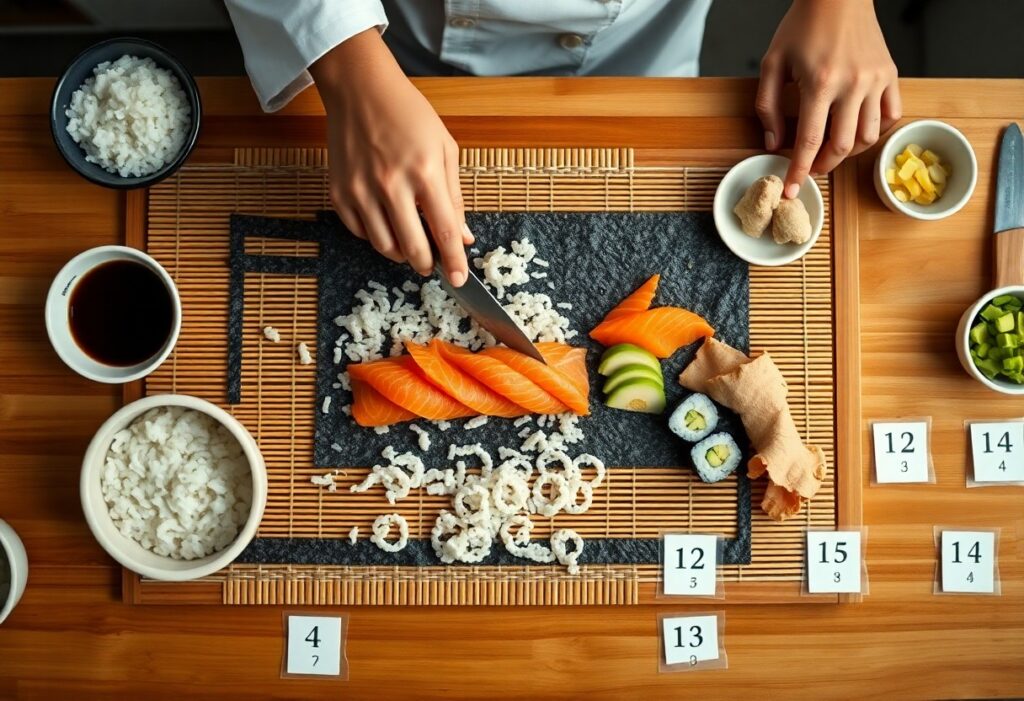
You will learn how to roll sushi at home in ten clear steps; pay attention to raw fish (sushi can carry parasites), practice technique and hygiene, and enjoy the result: fresh, tasty and impressive. Main Resource: How to Make Sushi – 10 Easy Steps
Key findings:
- Rice & Ingredients: Wash sushi rice carefully, season correctly and use only fresh ingredients.
- Technique & Tools: Nori sheets, bamboo mat and the right rolling technique (even pressure, damp hands) are crucial for clean rolls.
- Practice & Safety: Practice gradually, start with simple fillings, use a sharp knife and pay attention to hygiene and fish freshness.
Buy ingredients and equipment
You get rice, nori, fresh fish, rice vinegar, sugar, salt as well as bamboo mat and a sharp knife. Pay special attention to high-quality ingredients and a clean work surface. To get started , rice, nori and a good knife are the most important purchases.
Get fresh fish
You only buy sashimi-quality fish from a trusted retailer and ask for catch date and storage. Buy the same day or the morning of consumption so that the fish is really fresh .
Raw fish carries risks: Watch out for anisakis and bacteria. Many traders already supply frozenfish fillet (−20°C for at least 24-72 hours), which reduces parasites. If you’re pregnant or immunocompromised, avoid raw fish.
Sushi rice and seaweed leaves
You choose Japanese short-grain rice and wash it thoroughly until the water runs clear. Season the rice with rice vinegar, sugar, and salt to make it really sticky and flavorful. Keep nori dry and airtight.
With nori, look for freshness and dark, shiny leaves; the good quality of the rice makes a big difference in taste. Cut with a dry knife to get clean rolls.
Rough guidelines: rice to water approx. 1:1.1; for 300 g of uncooked rice , about 4 tablespoons of rice vinegar, 2 tablespoons of sugar, 1 teaspoon of salt for seasoning. Adjust the amount and sweetness to taste.
Washing the sushi rice
You’ll need to wash the rice thoroughly before cooking to remove excess starch and avoid sticky, mushy grains. Rinse the rice in a bowl of cold water, stirring gently and changing the water until it becomes largely clear. Be careful not to break the grains.
Use cold water
Always use cold water so that the rice does not swell prematurely or become sticky on the surface. Warm water can negatively affect the texture and lead to uneven cooking – avoid warm water. Change the water several times until it is much clearer.
Rinse starch thoroughly
You should rinse the starch thoroughly by gently circling the rice and draining the cloudy water. Repeat this process usually 3-5 times until the water is almost clear; this is how you achieve the desired grain separation and shine.
If necessary, use a fine sieve or hold your hand lightly over the rice to check if there is still white cloudiness. Rubbing too hard can damage grains, so work calmly and in a controlled manner for optimal consistency .
Cooking rice to perfection
Precision is important when it comes to sushi rice: wash correctly, dose exactly and steam gently. You rinse the rice until the water runs clear, let it soak and cook it with the lid closed over low heat. This way you achieve a sticky, but not mushy consistency.
The right water ratio
For sushi, you usually use a ratio of 1:1.1-1.2 (rice:water) by volume. If you use a rice cooker, follow its markings. Too much water makes the rice mushy, too little makes it hard and dry.
Let the rice swell
After washing, you should let the rice soak for at least 30 minutes (in cold water), preferably up to 1 hour. This allows it to absorb water evenly and cook evenly later, which is crucial for the right texture.
After cooking, let the rice rest for another 10-15 minutes so that steam disperses; then turn loosely with a rice spoon. Avoid stirring vigorously, or the grain will be destroyed and the rice will become sticky and overworked.
Prepare rice vinegar mixture
Prepare the rice vinegar mixture while the rice is cooking. Heat rice vinegar with sugar and salt only until everything comes off – do not boil. You pour the mixture over the still warm rice so that it gets shine and typical taste . Caution: Hot mixture may cause burns.
Vinegar, sugar, salt
For about 500 g of cooked sushi rice, use about 80 ml of rice vinegar, 3 tablespoons of sugar and 1 teaspoon of salt. Stir gently until the sugar is dissolved and taste. Adjust the balance: more vinegar for acidity, more sugar for sweetness; Important: Do not boil.
Carefully fold in
Using a wooden spatula, fold the mixture into the rice in a cutting, folding motion. You don’t press or the grains will become mushy. Work briskly while the rice is still warm and fan it out to allow steam to escape.
Ideally, use a wooden spatula and make 3-4 even passes from the outside to the inside; Do not crush. The goal is a fluffy, grainy, lukewarm rice with a shiny surface, ready to roll.
Cut the fillings
When preparing the fillings, cut evenly so that the rolls are clean and stable. Pay special attention to fresh ingredients and equal piece sizes for even rolling.
Work with a sharp knife and a non-slip cutting board. Pay attention to the bones of the fish and store sensitive ingredients in a cool place immediately until you process them.
Fish in strips
Remove the skin and bones, then cut the fish into strips of about 5-8 mm against the fiber. Use a sharp, clean knife and keep the fish cool until it is processed. Pay attention to bones, which you remove with tweezers.
Finely chop vegetables
Cut cucumber, carrot, bell pepper and avocado into thin, even sticks (julienne). Uniform pins provide better structure; pieces that are too thick can tear the roll open.
Remove seeds and excess moisture, pat the vegetables dry well , and use a mandolin or sharp knife if needed for clean, even sticks.
Prepare the workplace
Clear your area and have all the utensils ready: bamboo mat, sharp knife, rice, rice vinegar, bowl of water and a damp cloth. Make sure you have a clean, dry work surface and fresh ingredients.
Keep raw fish cool and separate work areas to avoid cross-contamination . Watch out for the sharp knife and slippery hands – dry them regularly.
Prepare bamboo mat
Lay the bamboo mat flat in front of you and cover it with plastic wrap to prevent rice from sticking and keep the mat clean. The mat should be freely movable.
Position the chopsticks so that you can roll comfortably and be careful not to wrap too tightly: roll loosely but compactly .
Place nori sheet
Place the nori sheet with the shiny side down and the rough side up so that the rice adheres better. Check for cracks and freshness: dry, undamaged nori is important.
Leave about 1-2 cm free at the top so that you can close the roll well. Spread the rice evenly, but not too much, or the roll won’t close.
Place the nori so that the open end is facing away from you; keep it dry, because moisture makes it soft and makes it crack when rolling.
Distribute rice evenly
Spread the sushi rice evenly over the nori, leaving about 1-2 cm of edge at the top. Make sure your hands are clean and press the rice only lightly so that the roll remains stable later. For a step-by-step guide: How to make your own sushi | Recipe guide for beginners.
Spread the rice so that it is not too thick; too much rice makes the roll heavy and unstable. Avoid holes and uneven layers so that the roll doesn’t fall apart when cutting.
Lightly moisten hands
Lightly moisten your hands with water or rice vinegar to prevent the rice from sticking. Use only a thin layer of moisture; not too wet, otherwise the rice will be mushy. Shape and spread the rice with flat hand movements.
Leave the top edge blank
Leave a border of about 1-2 cm free at the top so that you can close the roll cleanly. This free edge is crucial for the nori to stick together when rolling and hold the filling securely.
More info: If necessary, remove rice that protrudes over the edge and press the seam firmly with damp fingers, but not too hard so that the roll is not compressed. Avoid overcrowding the roll.
Shaping the Role
When forming the roll, make sure that all the ingredients are in the middle and that the nori remains free at the top edge. Use the bamboo mat, hold it close to the filling and pull it up evenly as you form the roll. Less filling prevents leakage, a few drops of water help with sealing.
Roll up carefully
Roll slowly and in a controlled manner, pressing with the palms of your hands from below, not with your fingers. Lift the mat slightly to release air and pull it as soon as the nori sticks to itself. Pressing too hard can crush the rice or tear the nori; gentle pressure ensures a compact, even roll.
Apply even pressure
Spread the pressure along the roll with both hands, roll in small steps and correct the shape as you go. Keep the tension constant so that the roll doesn’t get thicker at one end. Uniform pressure is crucial for a stable structure and clean cutting results.
Test the firmness by pressing lightly on the roller: it should give way, but not burst. If too much rice spills out, the pressure was too strong; if the roll is too loose, a little more tension helps. Use a sharp, moistened knife for clean pieces to slice.
Cutting the Roll
Before you cut open the roll, let it rest for a short time so that the ingredients set. Cut with a steady hand and avoid crushing the roll; The aim is to achieve uniform slices.
Place the knife straight, press lightly and pull through the roll in a clean motion. Use a sharp knife and wipe the blade between cuts to get clean cuts .
Use a sharp knife
Use a long, thin blade (sushi or sashimi knife) and keep it sharp. A sharp knife ensures precise slices; Caution: Risk of cutting, work slowly and in a controlled manner.
Slightly moisten the blade
Wet the blade briefly with water or on a damp cloth before each cut.
Dip the tip only briefly in water or stroke the blade over a slightly damp cloth; Avoid getting dripping wet . Wipe the blade between each cut to prevent sticking and to achieve even slices .
Serve and enjoy
When serving, arrange each roll neatly and cut it with a sharp knife. Pay attention to fresh fish and hygiene, because raw fish can be dangerous.
Beautiful plating enhances enjoyment – use subtle garnishes and serve immediately to keep texture and temperature optimal.
Soy sauce and wasabi
Use small bowls and dip the roll only lightly in the soy sauce; avoid long immersion so the rice doesn’t fall apart. Soy sauce is very salty – dose it sparingly.
For wasabi, it’s better to apply a small amount to the roll instead of mixing it completely; use sparingly because it is very spicy.
Serve with ginger
Serve pickled ginger as a flavor break: You take a piece between two bites to cleanse the palate and separate the flavors – ginger cleanses.
Don’t put too much ginger at once and don’t use it as a topping, but as a companion for intermediate steps.
Pay attention to quality: pink ginger indicates young root, keep it refrigerated and discard it immediately if it smells or looks unusual.
Result
You have now learned the basics and can make fine rolls with practice. Pay special attention to hygiene and proper handling of raw fish, as incorrect storage can be dangerous . Use trusted recipes like make your own sushi | Recipe – Migusto as a guide.
With patience, you’ll develop precise technique and get better results every time; it’s fun and rewarding.
FAQ
Q: What ingredients and tools do I absolutely need for my first sushi roll experience?
A: Basic Ingredients: Sushi Rice (Short Grain), Rice Vinegar, Sugar, Salt, Nori Sheets; possible fillings: sashimi-quality fish (only from trusted supplier), salmon/tuna, avocado, cucumber, pickled radish, cream cheese or tempura prawns; Tools: Bamboo sushi mat (makisu), sharp long knife, rice bowl (hangiri or large bowl), rice spatula, bowl of water/vinegar for wetting fingers, cling film.
Q: How do I prepare the sushi rice in 10 practical steps?
A: 1) Weigh the rice, 2) wash thoroughly until the water runs clear, 3) soak for 30-60 minutes, 4) cook in a pot or rice cooker with the right amount of water, 5) let it rest for a short time, 6) heat and dissolve rice vinegar with sugar and salt, 7) put the hot rice in a shallow bowl, 8) fold in vinegar evenly, 9) cool with fans and adjust stickiness, 10) Bring the rice to room temperature and portion it out.
Q: What do I have to pay attention to when rolling and which mistakes are better avoided?
A: Mat side of the nori facing inwards (rough side facing the rice), do not use too much rice/filling, spread evenly (leave about 1 cm edge up), damp fingers prevent sticking, roll the mat tightly but without excessive pressure, shape the roll with mat and tighten, moisten the end edge with a little water, common mistakes: overfilling, rolling too loosely, too much rice, Cut nori upside down or not moistened.
Q: Can I use raw fish and how do I avoid risks?
A: Use raw fish only in sashimi/sushi quality from trusted dealers and transport refrigerated; to reduce parasites, freezing is often recommended (follow the manufacturer’s instructions). Alternative safe fillings: smoked salmon, cooked shrimp, canned tuna, tempura vegetables, or marinated mushrooms.
Q: How do I cut sushi rolls clean and how do I store leftovers properly?
A: Keep knives very sharp and moist, wipe between each cut, cut with a pulling motion and without chopping, remove end pieces before serving; Wrap leftovers airtight in cling film and store in the refrigerator until the next day at most, but serve fresh, as rice hardens and loses flavor when cooled.